WOS conference day one
May. 24th, 2026 11:37 am![[personal profile]](https://www.dreamwidth.org/img/silk/identity/user.png) tiggymalvern
tiggymalvern
Last weekend was the annual ornithological society conference, which this year was in the far eastern part of the state on the border with Idaho. I spent the first day in Whitman county in the Palouse.
The Palouse is mostly a massive agricultural desert. A giant expanse of farmland with no trees, no hedgerows, not a promising place for birds. You'll see a few raptors as you drive around, a few kingbirds catching insects from the wires, maybe a few quail and horned larks, starlings near the farms themselves, but it's not great for wildlife.

So you head for the few exceptions, which include some hills here and there which are too steep to farm the sides of, including this one, Steptoe Butte.
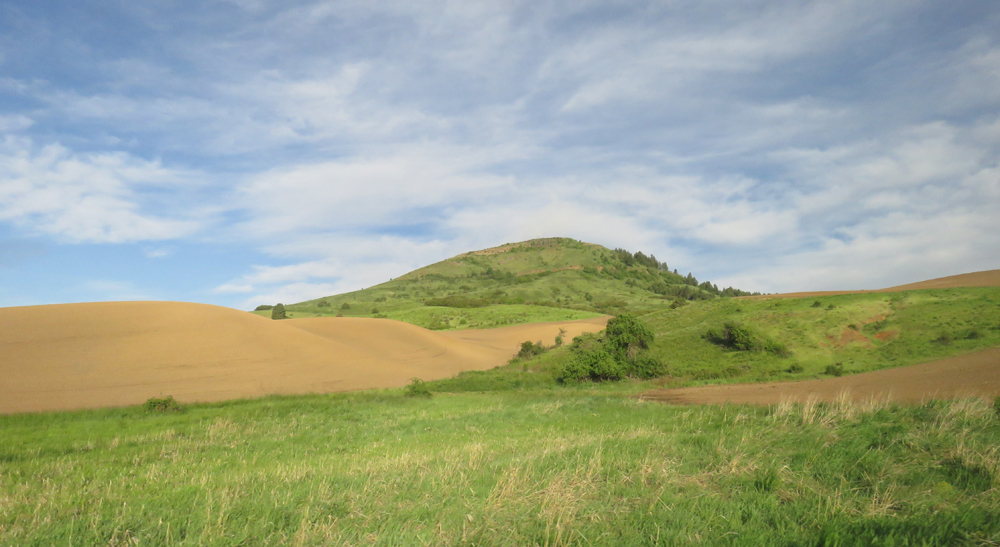
Here there are a few trees, some bushes and some of the native prairie grassland, so that's where you find the birds. The Palouse prairie is considered one of the most endangered ecosystems in the world, because more than 99% of it was ploughed up for agriculture.

Native irises.

View from the top of Steptoe Butte at 3600 feet/ 1100 metres. The geology of the Palouse is crazy - low rolling waves of land from horizon to horizon. It's a landscape created by HUGE floods that happened during the ice ages. The land would be covered in glaciers that would then melt and floodwaters would rush out of giant lakes and cover half of Washington state. Think of when you go to the beach when the tide's gone out and the sand is full of ripples where the waves ran over it. That immense rolling landscape is the ripples in the sand, but a thousand times larger because that's how fierce the floods were.

Before the colonists came, this was prairie dotted with ponds and patches of trees. The ponds were drained and the trees cut down by the farmers. Imagine how it looked when all that land was like the foreground, with herds of buffalo and wolf packs.

After Steptoe Butte, we moved on to Kamiak Butte, which is similar but more heavily wooded. There's no road up this one, so we got to take the two and a half mile loop hike up and around.
Arnica and false Solomon's seal growing in the understorey.

The flowers of the ponderosa pine are big and dramatic.

Some more open patches along the ridge at the top allow views between the trees.

Indian paintbrush flower and (I think) a Morrison's bumblebee.

Flowering shrub on Kamiak Butte.

Our final stop for the day was the Rose Creek Nature Preserve near Pullman, which is apparently the best example of the quaking aspen-black hawthorn community remaining in the Palouse. It has a lot of dense bushes with a creek and some wetland and a bit of prairie sloping up towards farmland.
Male Calliope hummingbird at Rose Creek.

Western Bluebird.

It was a great day, mixed sun and clouds, no rain, but it was never warm! At lunchtime at the top of Kamiak Butte when the sun came out, I was able to peel off my coat and spend the rest of the day in just layers of T-shirt, light sweatshirt and thick sweatshirt. The people who had not brought gloves spent the early part of the day regretting that...
The Palouse is mostly a massive agricultural desert. A giant expanse of farmland with no trees, no hedgerows, not a promising place for birds. You'll see a few raptors as you drive around, a few kingbirds catching insects from the wires, maybe a few quail and horned larks, starlings near the farms themselves, but it's not great for wildlife.
So you head for the few exceptions, which include some hills here and there which are too steep to farm the sides of, including this one, Steptoe Butte.
Here there are a few trees, some bushes and some of the native prairie grassland, so that's where you find the birds. The Palouse prairie is considered one of the most endangered ecosystems in the world, because more than 99% of it was ploughed up for agriculture.
Native irises.
View from the top of Steptoe Butte at 3600 feet/ 1100 metres. The geology of the Palouse is crazy - low rolling waves of land from horizon to horizon. It's a landscape created by HUGE floods that happened during the ice ages. The land would be covered in glaciers that would then melt and floodwaters would rush out of giant lakes and cover half of Washington state. Think of when you go to the beach when the tide's gone out and the sand is full of ripples where the waves ran over it. That immense rolling landscape is the ripples in the sand, but a thousand times larger because that's how fierce the floods were.
Before the colonists came, this was prairie dotted with ponds and patches of trees. The ponds were drained and the trees cut down by the farmers. Imagine how it looked when all that land was like the foreground, with herds of buffalo and wolf packs.
After Steptoe Butte, we moved on to Kamiak Butte, which is similar but more heavily wooded. There's no road up this one, so we got to take the two and a half mile loop hike up and around.
Arnica and false Solomon's seal growing in the understorey.
The flowers of the ponderosa pine are big and dramatic.
Some more open patches along the ridge at the top allow views between the trees.
Indian paintbrush flower and (I think) a Morrison's bumblebee.
Flowering shrub on Kamiak Butte.
Our final stop for the day was the Rose Creek Nature Preserve near Pullman, which is apparently the best example of the quaking aspen-black hawthorn community remaining in the Palouse. It has a lot of dense bushes with a creek and some wetland and a bit of prairie sloping up towards farmland.
Male Calliope hummingbird at Rose Creek.
Western Bluebird.
It was a great day, mixed sun and clouds, no rain, but it was never warm! At lunchtime at the top of Kamiak Butte when the sun came out, I was able to peel off my coat and spend the rest of the day in just layers of T-shirt, light sweatshirt and thick sweatshirt. The people who had not brought gloves spent the early part of the day regretting that...


no subject
Date: 2026-05-24 09:25 pm (UTC)The irises, ponderosa pine, Indian paintbrush, and hummingbird are my favourite shots, but they're all perfect. I'm glad you got to have such a great day ❤️
no subject
Date: 2026-05-25 03:42 am (UTC)Not exactly against my will - there are always some flower people on the birding trips, and I do like learning the flowers. It's just that half of them I forget again straight away!
no subject
Date: 2026-05-24 10:27 pm (UTC)Glad you got some nice weather to enjoy your outing. ❤
no subject
Date: 2026-05-25 03:43 am (UTC)